
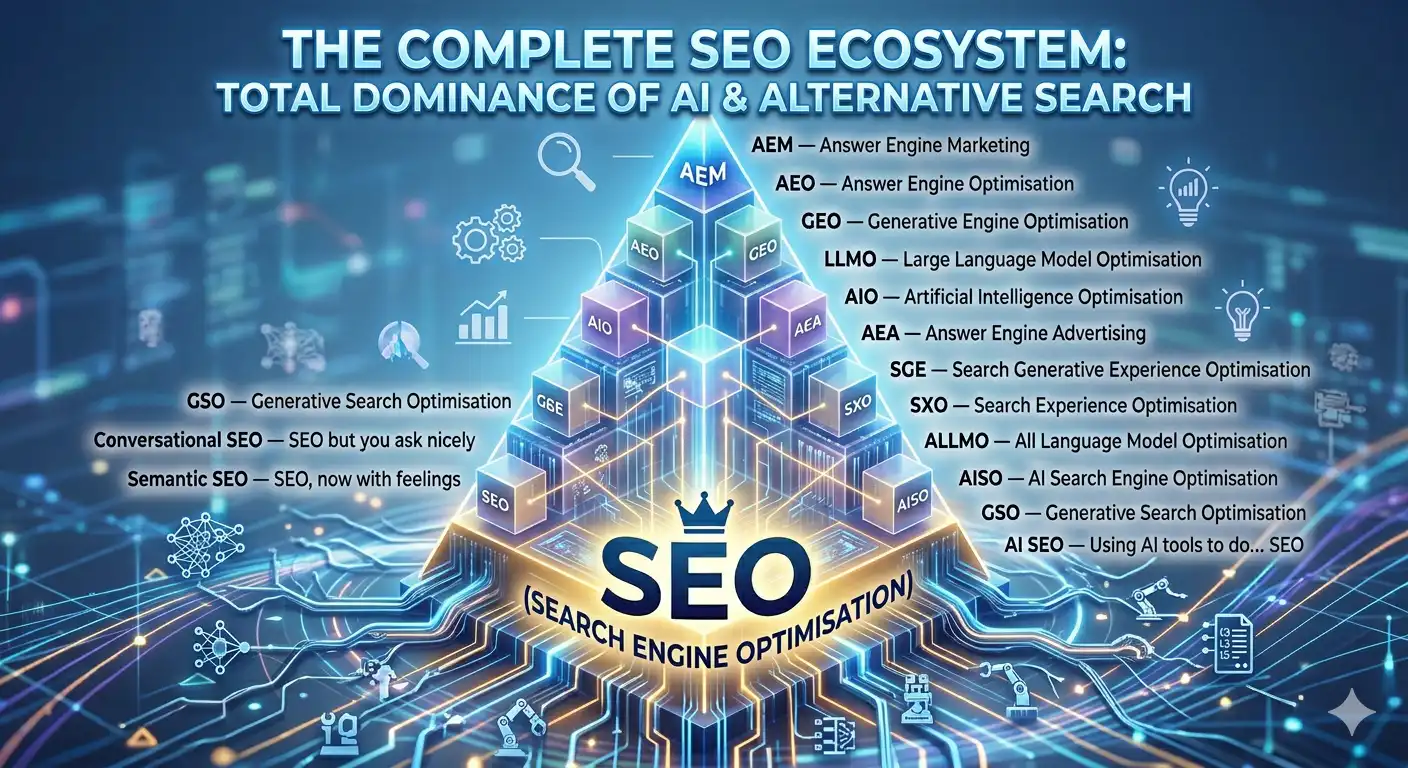
Why AEM, AEO and SEO are all the same game,
and why links are still the only move that matters
There is a conversation happening right now in B2B marketing circles that has real consequences for how companies allocate their budgets, their time, and their trust. This is mostly being played out on LinkedIn and it goes like this: SEO is dead, AI has changed everything, and your B2B SEO strategy needs to be torn up and rebuilt around concepts called AEM (Answer Engine Marketing) and AEO (Answer Engine Optimisation). The new goal, according to this school of thought, is simple, just be the answer. Structure your content for AI. Be comprehensive. Be helpful. And the results will follow.
I’ve been running B2B SEO strategy for long enough to know when something is genuinely new and when something is old wine in a new bottle. This is old wine. Very old wine. And I can prove it, not just with an argument, but with a real-world B2B website, an independent AI visibility audit, and a report that unintentionally hands me my entire case on a plate.
Let me walk you through it.
The B2B SEO Strategy Debate That Won’t Die
A post appeared in my LinkedIn feed recently from a marketer who I follow he was reposting a comment from another marketer making the claim that AI visibility is fundamentally about being the answer. The implication was that if your content is genuinely the best, most comprehensive response to a given query, the AI will find you, surface you, and reward you. Content quality as the sole currency. A pure meritocracy.
My response was direct: try ranking on content alone and see how far you get.
I’m not saying content doesn’t matter, of course it does. But “being the answer” is not a distribution strategy. It is not a ranking strategy. It is not even an AI visibility strategy on its own. It is a prerequisite, not a differentiator. Everyone in a competitive B2B niche is trying to be the answer. The question is why Google and therefore the AI systems that drink from Google’s well chooses your answer over everyone else’s.
And the honest answer to that question, in 2026 as much as in 1998 (When I started), comes back to authority signals. Which, in practice, means links.
I decided to put this to the test by running Onion through an AI visibility tool, ScopeSite’s V.O.I.C.E. checker to see the results. I’ll share exactly what it found. Interestingly the report didn’t just fail to disprove my argument. It made it for me, in its own words. I actually like the tool. It has a nice interface and website and I could see myself using it. There are some errors in the report but nothing that can’t be fixed easily.
Exhibit A: The B2B SEO Case Study Sitting Right Under My Nose
Let me put some evidence on the table.
Onion.Training is an EdTech platform dedicated to software testing education. It is, without exaggeration, one of the most comprehensive resources on the subject you will find anywhere online. The site contains answers to practically every software testing question a learner or practitioner might ask. It has a 900-term glossary nine hundred defined terms, carefully written, properly structured, internally linked. It has articles, FAQs, schema markup, table of contents structures, fast performance scores, and clean technical foundations.
In other words, it has everything the AEM crowd would point to as the formula for AI visibility. It is the answer. It is comprehensive. It is structured in exactly the way that should make AI models love it.
And yet: crickets.
Not because the content is bad. Not because the site is technically broken. Not because the schema is missing or the FAQs aren’t formatted correctly. The reason Onion.Training isn’t flying in organic rankings, or appearing prominently in AI-generated responses is simple and blunt:
It has no inbound links worth speaking of.
The site exists in a bubble. Its authority hasn’t been vouched for by the rest of the web. From Google’s perspective, and from the perspective of every AI system that relies on Google’s index as its primary data source, Onion.Training is a room full of excellent answers that nobody has pointed to. And in the attention economy of search, if nobody points to you, you don’t exist at the scale required to compete.
There is important context here. Onion.Training was never built to rank. It was built to support an EdTech business that acquires clients through industry conferences, professional meetups, and direct relationships. The B2B route to market in software testing education doesn’t require Google. It requires reputation within a specific professional community and that reputation has been earned in rooms, not on results pages.
But the moment you ask whether that site could compete for B2C software testing course traffic, or whether it would surface consistently in AI-generated responses, the answer is no, not yet, and not without a link building strategy behind it.
That’s the honest truth. And it’s the same truth that was honest in 1998 when I started learning SEO.
The Report That Proved My Point for Me
Here’s where it gets interesting.
After my LinkedIn exchange, I ran the ScopeSite V.O.I.C.E. AI Visibility Checker against Onion.Training. The tool is specifically designed to measure how visible a site is to AI assistants. it’s positioned squarely in the AEO space, built on the premise that AI visibility is a distinct and measurable discipline. If any tool was going to vindicate the “be the answer” camp, this was it.
Instead, it handed me my argument gift-wrapped.
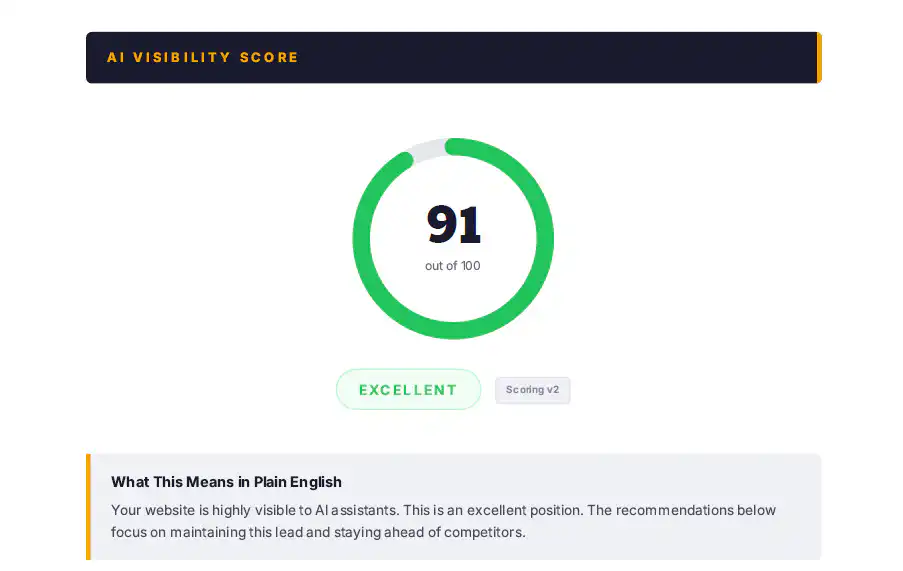
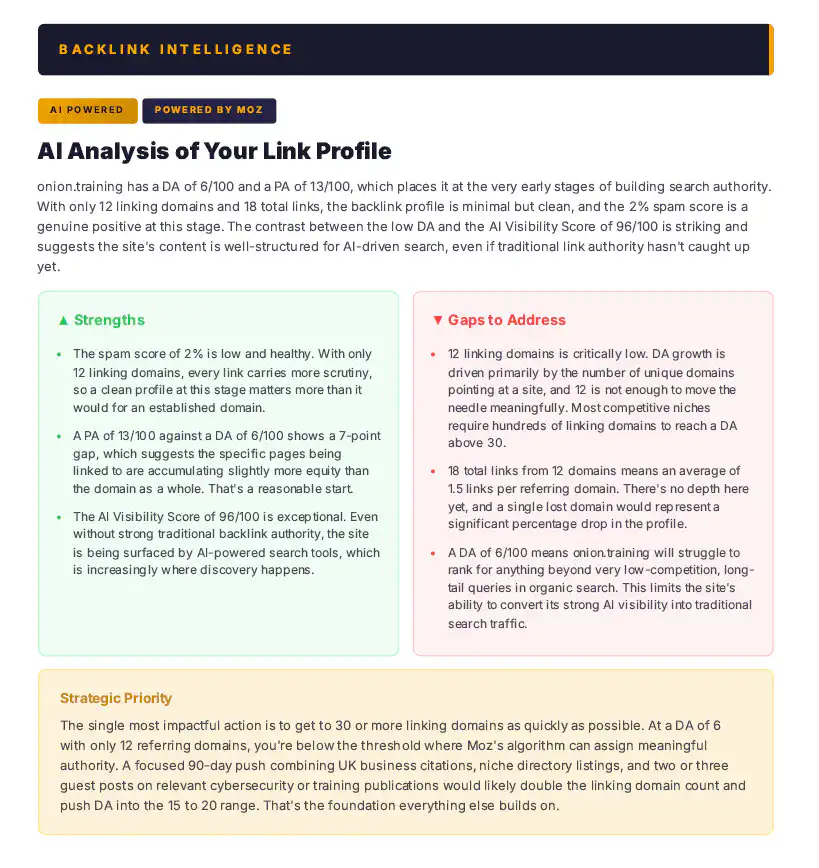
The report opens by awarding Onion.Training an AI Visibility Score of 91 out of 100, classified as “Excellent” (ScopeSite V.O.I.C.E. Report, p.2). On first glance, that appears to support the AEM position, a high score for a content-rich, well-structured site. Look closer, though.
“Domain Authority sits at just 6/100 with only 12 linking domains, this is the single biggest constraint on AI visibility and organic reach, as AI systems weight authoritative, well-cited sources more heavily.” (Report, p.4)
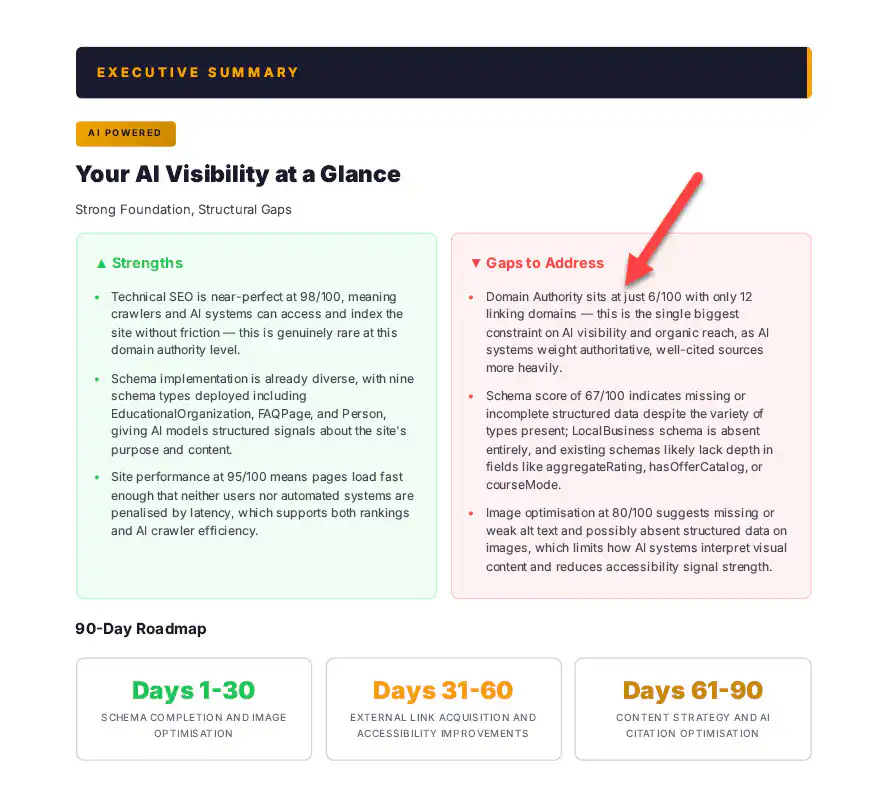
The single biggest constraint on AI visibility. Their words. Not mine.
The tool then records a Domain Authority of 6/100, driven by just 12 linking domains and 18 total links (Report, p.3). The spam score is a clean 2%, which means the links it does have are legitimate. But 18 links from 12 domains is, as the report itself puts it, “minimal” (Report, p.8).
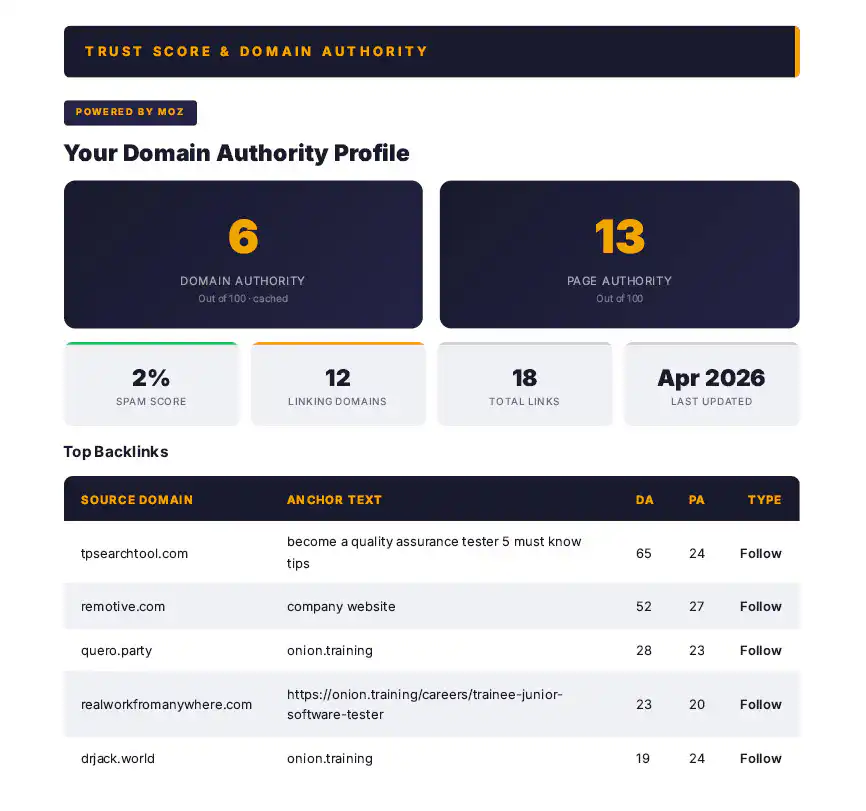
The dedicated backlink analysis section, labelled “Backlink Intelligence” (Report, p.8) identifies this as a CRITICAL priority (Report, p.9):
“With only 12 linking domains and a Domain Authority of just 6/100, this site has nowhere near enough external websites pointing to it to compete in search results. Search engines treat links from other websites like votes of confidence. At 12 linking domains, this site has barely any votes at all.” (Report, p.7)
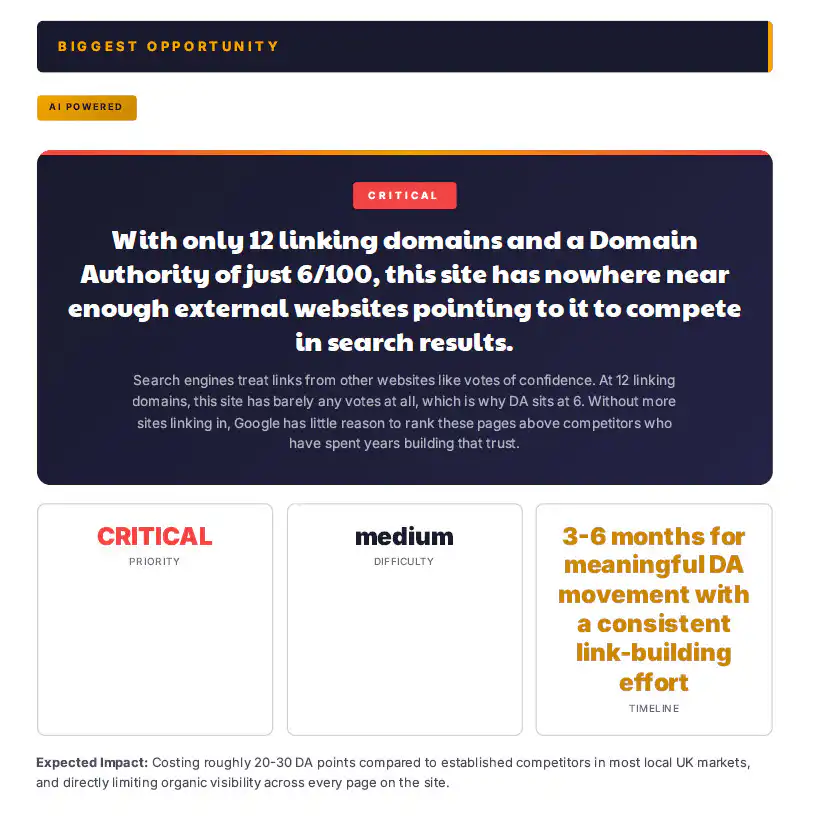
That is an AI visibility tool, built to promote AEO, explaining in plain English that this site can’t compete because it doesn’t have enough links. I couldn’t have written a better summary of my b2b seo strategy argument myself if I had tried.
The 90-day improvement roadmap the report provides is equally revealing. Days 1–30: schema and image fixes. Days 31–60: external link acquisition. Days 61–90: content and citation strategy (Report, p.4). Link building sits at the centre of the action plan. Because without it, nothing else matters enough to move the needle.
The Score Contradiction Nobody Mentioned
While we’re examining the report honestly, there’s an inconsistency worth flagging.
The scoring page clearly shows 91 out of 100 as the AI Visibility Score (Report, p.2). Yet later, in the Backlink Intelligence section, the same report references an AI Visibility Score of “96/100” for the same site (Report, p.8). A five-point discrepancy within the same document, for the same site, generated on the same day.
I’m not raising this to criticise the tool, automated reports of this complexity will occasionally contain inconsistencies. I’m also a professional software tester so I EXPECT bugs in all software development. It is after all why we created Onion. I’m raising it because it illustrates a broader point: these AI visibility scores, however impressively packaged, are composite metrics built on weighted assumptions. They are not objective measurements of whether your site actually appears in AI responses. They are measurements of whether your site has the technical attributes that should, in theory, support AI visibility.
That distinction matters enormously. Onion.Training scores 91 (or 96, depending which page you read) for AI visibility. In practice, it gets crickets. The score reflects readiness. It does not reflect reality. And any B2B SEO strategy built on “improving your AI readiness score” without addressing link authority is building on sand.
AI Readiness vs AI Presence: The Gap at the Heart of the AEO Argument
This is the flaw at the heart of the AEO proposition, and the report inadvertently exposes it.
The V.O.I.C.E. tool measures whether AI crawlers can access your site, whether schema markup is correctly implemented, whether performance scores are healthy, and whether structured data helps machines understand your content. All of these are genuine and measurable signals. As I said I DO like the tool.
Onion.Training scores well across all of them:
- Technical SEO rated at 98/100 (Report, p.4)
- Site performance at 95/100 (Report, p.4)
- All major AI bots, GPTBot, ClaudeBot, CCBot, Google-Extended, explicitly allowed in robots.txt (Report, p.22)
- An llms.txt file present, providing direct guidance to large language models (Report, p.22)
- Ten schema types correctly implemented, including EducationalOrganization, FAQPage, and Person (Report, p.6)
That is an exceptional technical foundation. The site is, by every measurable signal, ready for AI. The door is wide open. The crawlers are allowed in. The schema is telling them exactly what the site is about.
And yet they’re still not sending traffic. Because the site isn’t authoritative enough to surface in results, and authority is communicated through links.
AI readiness is necessary but not sufficient. You can have a perfectly prepared stage, professional lighting, a full script, and an empty theatre, and still perform to nobody. The links are what fill the theatre. The report confirms this directly:
“A DA of 6/100 means onion.training will struggle to rank for anything beyond very low-competition, long-tail queries in organic search. This limits the site’s ability to convert its strong AI visibility into traditional search traffic.” (Report, p.8)
Strong AI visibility score. Can’t convert it into traffic. Because no links. That is not a vindication of AEO. That is an illustration of its limits.
Why AI Doesn’t Just Crown the Best Answer
The implicit assumption in “be the answer” is that AI systems are independently evaluating content quality across the entire web and surfacing the most objectively accurate, helpful responses. That’s a flattering picture of how these systems work. It’s also largely incorrect.
We are 15DegreesNorth were involved directly in Beta testing Ai in its early stages. We know full well how it works. However.
I put this directly to Gemini, asking where it gets its search-surfaced results from. The response was instructive.
“AI-powered search tools, Google’s AI Overviews, Bing Copilot, Perplexity, and others, are not crawling the web independently and judging content on pure merit. They draw primarily from the existing ranked index of Google (or Bing). They then use their language model capabilities to synthesise and present that information in a conversational format.”
If you’re not already ranking well in traditional search, you’re not going to appear in AI-generated answers.
AI isn’t going to discover your brilliant, comprehensive, link-poor site and decide to feature it because the content is excellent. It’s going to surface the sites that have already earned authority in Google’s (Rank Brains) eyes, sites with content and links and technical foundations and age and engagement signals.
AI is a layer on top of SEO. A more conversational, synthesised layer, but built on the same foundation. You cannot skip the foundation and access the layer above it.
The V.O.I.C.E. report acknowledges this: “The single most impactful action is to get to 30 or more linking domains as quickly as possible… That’s the foundation everything else builds on.” (Report, p.8)
Everything else builds on links. In an AEO report. In 2026.
AEM, AEO and SEO: Same B2B SEO Strategy, Different Label on the Tin
Let’s address the naming debate head-on, because it matters.
The argument that AEM and AEO represent something fundamentally different from SEO is, at its core, a rebranding exercise. “SEO” has accumulated years of baggage, keyword stuffing, link farms, grey-hat tricks. Calling something “Answer Engine Optimisation” sounds fresh, forward-thinking, and AI-native. It’s good marketing for a service offering. Remember the Metaverse LOL.
But here is the most revealing detail in this entire story: look at what the V.O.I.C.E. tool actually measures. The acronym stands for Visibility, Optimisation for Intelligent Crawler Engines (Report, p.24). And here is what the tool’s scan includes (Report, p.24):
- AI GEO Visibility Score with weighted breakdown
- Schema.org validation
- Core Web Vitals analysis via Google’s PageSpeed API
- AI crawler access check
- Domain Authority and backlink data from the Moz API
- Competitor benchmarking
- Platform-specific implementation guides
That is a B2B SEO audit. Presented in AEO packaging, but built entirely on the same signals that SEO practitioners have been measuring for two decades. Domain Authority. Backlink data. Core Web Vitals. Schema. Crawler access.
Here’s what any AEO practitioner will tell you your strategy requires:
Comprehensive authoritative content
Clear structure
Schema markup
Fast performance
Topical authority
Signals from other authoritative sources. i.e., links.
Here’s what any SEO practitioner will tell you your b2b seo strategy requires:
Comprehensive authoritative content
Clear structure
Schema markup
Fast performance
Topical authority
Signals from other authoritative sources i.e., links.
The lists are identical. The methodology is identical. The ranking factors are identical. The only meaningful difference is the vocabulary.
This isn’t a new discipline. It’s SEO with a fresh coat of paint, sold to people who’ve been told SEO is dead. SEO is not dead. The core principle, demonstrate authority and relevance to earn visibility has remained constant since Google launched. AEM and AEO are the latest iteration of that same principle, adapted to describe AI-surfaced results rather than blue-link pages.
Calling it something different doesn’t change what you have to do to achieve it.
The One Exception: When Content Can Win Without Links
To be fair, and fairness matters here, there are scenarios where content alone can drive visibility without a substantial link building effort behind it. It’s worth being precise about when that’s true.
In a niche with no meaningful competition, what we SEOs call an “NA phrase”, you really can show up with a comprehensive, well-structured piece and rank. Google isn’t stupid. When there’s a genuine information gap and you fill it properly, it will often reward that even without a strong backlink profile.
There are corners of the internet where this still happens: highly technical queries in nascent industries, emerging topics not yet crowded by content mills, hyper-local searches with thin competition. In these scenarios, good content does get you somewhere.
But the moment you step into a competitive B2B niche, software testing, digital marketing, financial services, health tech, legal, manufacturing, the advantage evaporates. You are now competing against sites that have been earning links for years, sometimes decades. Sites with Domain Authority in the 50s, 60s, and 70s. Sites with hundreds or thousands of referring domains.
The V.O.I.C.E. report confirms this: DA 6 with 12 referring domains puts Onion.Training “below the threshold where Moz’s algorithm can assign meaningful authority” and most competitive niches require hundreds of linking domains to reach a DA above 30 (Report, p.8). No content strategy alone bridges that gap.
What a Sound B2B SEO Strategy Actually Requires
Let’s return to the example with the audit data in hand, because it shows the path forward with precision.
The report confirms the site has everything right on the technical and content side. Technical SEO at 98/100. Performance at 95/100. Ten schema types correctly implemented. AI crawlers explicitly welcomed. An llms.txt file in place. The entire on-page and technical infrastructure is better than most established sites in this space (Report, p.4).
But the report’s own priority action list, every high-impact item, points in one direction (Report, p.23):
- Submit to UK training and education directories (Coursecheck.co.uk, CPD Certification Service, Bark.com)
- Claim Google Business Profile, Bing Places, and Apple Maps listings
- Identify UK-based HR, L&D and training blogs for guest contributor posts
- Register on LinkedIn and Crunchbase with verified backlinks
- Request links from existing clients and training partners (Report, pp.10–11)
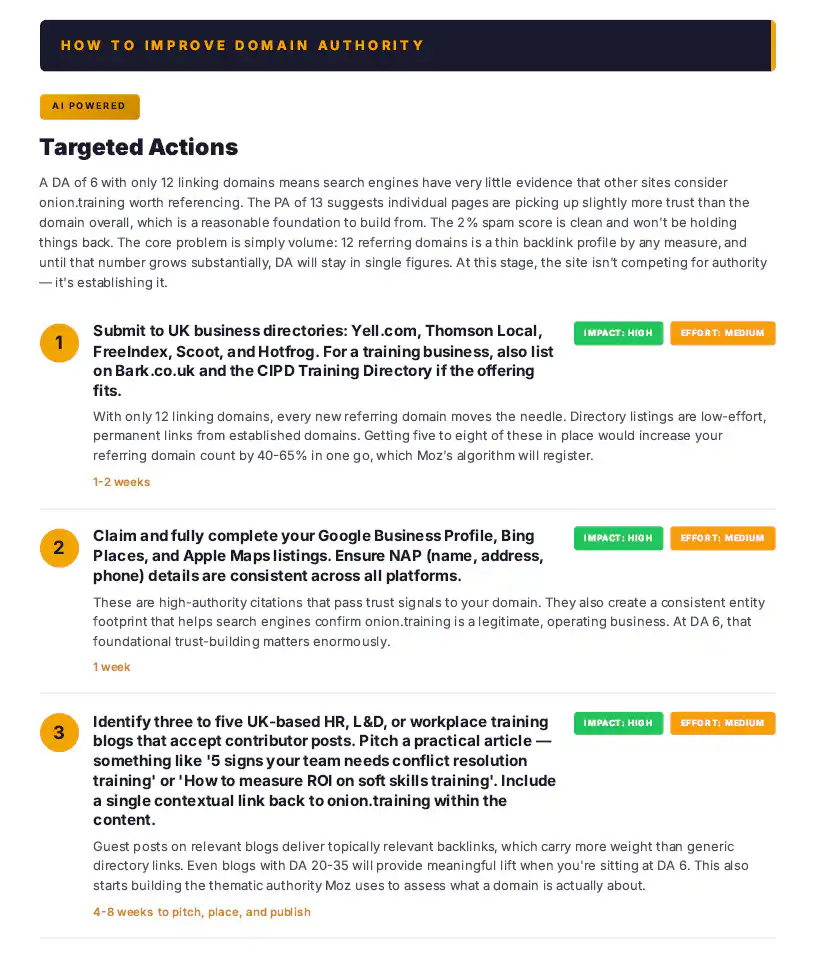
None of this is AEO. None of it is AEM. It is link building. It is outreach. It is the same foundational SEO work that sits at the core of every effective b2b seo strategy, and it is exactly what the AEO tool itself recommends when asked to give honest, evidence-based guidance.
The report even quantifies the gap: two or three new editorial links could push DA to 8–10 on their own, and targeting 3–5 new referring domains per month for six months would represent meaningful progress (Report, pp.10, 12). That is not a content plan. That is a link building plan. Dressed in AEO language, but link building all the same.
The Real Danger of Rebranding Old Problems
There’s a cost to the AEM/AEO framing that goes beyond academic disagreement about terminology.
When B2B businesses are told that SEO is dead (see LinkedIn and Youtube) and AI has changed everything, they sometimes make the mistake of abandoning foundational work in pursuit of the new thing. They stop building links because they’ve been told links don’t matter to AI. They focus exclusively on content. They invest in schema and voice search and AI-specific optimisation, all worthwhile, while neglecting the authority signals that determine whether any of it gets seen.
The result? They invest, they create, they optimise, and they rank nowhere.
A business that followed AEO advice to the letter, built excellent content with perfect schema and technical foundations, and never built links would look exactly like Onion.Training’s organic performance. Excellent on paper. Invisible in practice.
The “be the answer” philosophy tells people half the truth. Content matters. Structured data matters. Comprehensiveness matters. All real. But it is incomplete without authority, and in search, authority is primarily communicated through links. If you’re selling AEO or AEM services without including link acquisition in the strategy, you’re selling an incomplete solution. A well-intentioned one, but incomplete.
What AI Has Actually Changed (And What Hasn’t)
To be completely fair: AI has changed real things. It would be wrong to argue otherwise.
The format of search results has evolved. AI Overviews, featured snippets, and conversational responses mean the goal isn’t always a click, sometimes it’s to be cited in the answer, which requires being in the top results but not necessarily position one. E-E-A-T (Experience, Expertise, Authoritativeness, Trustworthiness) has intensified as a signal. Structured data has become more valuable as it feeds directly into how AI systems parse content. Topical authority matters more than ever, a coherent body of work establishing deep expertise outperforms a single excellent piece.
The V.O.I.C.E. report reflects these shifts well. Its recommendations around Course schema, Speakable schema for voice search, and FAQ markup targeting high-volume queries are all legitimate (Report, pp.18, 21). These are genuine improvements any b2b seo strategy should include.
But what has not changed: the foundational role of links in communicating authority. The importance of technical performance. The fact that Google’s index is the primary input for most AI search experiences. The basic truth that you must be found before you can be helpful.
AEM and AEO have correctly identified what has changed and built a service category around it. That’s smart. But they’ve underplayed what hasn’t changed, and in doing so, risk steering clients away from the work that actually moves the needle.
The Bottom Line on B2B SEO Strategy
You can have the best content on the internet. You can be the definitive answer to every question in your niche. You can have a perfect technical score, lightning-fast performance, ten schema types correctly implemented, a 900-term glossary, AI crawlers explicitly welcomed, and an llms.txt file pointing them directly at your content.
And you can still rank nowhere, appear nowhere in AI results, and receive crickets from Google.
Onion.Training is that example, made real and independently verified, not by my own audit, but by an AI visibility tool built by the people making the AEO argument. Their own report, on their own tool, using their own data, identifies the same single critical weakness: 12 linking domains, Domain Authority 6, and no meaningful path to visibility until that changes (Report, pp.3–4, 7–9).
That is not a coincidence. That is the physics of search, operating exactly as it always has.
AEM is SEO. AEO is SEO. V.O.I.C.E. is a B2B SEO audit tool. Answer Engine Marketing and Answer Engine Optimisation are SEO with a rebrand for the AI era, and the tactics within them are genuinely useful. But they are not a replacement for a sound b2b seo strategy. They are an evolution of one.
The game is the same game. The team without links is still losing. Build the foundation first. Everything else follows.
The ScopeSite V.O.I.C.E. AI Visibility Report referenced throughout this post was run against Onion.Training on 17 April 2026. The Password to download the report is onion
Need an honest assessment of what your own B2B SEO strategy is missing? Start with a B2B SEO audit and find out exactly where the gaps are, before investing another penny in content.