
The Free Ikigai Test Powered by AI: Find Your Purpose with IKIG-AI
Most purpose frameworks fail at the first hurdle! They ask questions too vague to answer honestly, return results that could apply to anyone, and leave you exactly where you started: knowing roughly what you care about but no clearer on what to do about it.
A good Ikigai test is different. It does not ask you to pick a personality type from a list or rank your values in order of importance. It asks four specific, honest questions and finds the place where all four answers intersect. That intersection is your Ikigai: your reason for being.
IKIG-AI is a free Ikigai test built by 15DegreesNorth that uses Claude AI to analyse your specific answers and return a genuinely personal result. Not a template. Not a worksheet that emails you a PDF. A real analysis of what you wrote, built around the four-circle Ikigai framework, that tells you where you are, where the gaps are, and what to do next.
What is an Ikigai test?
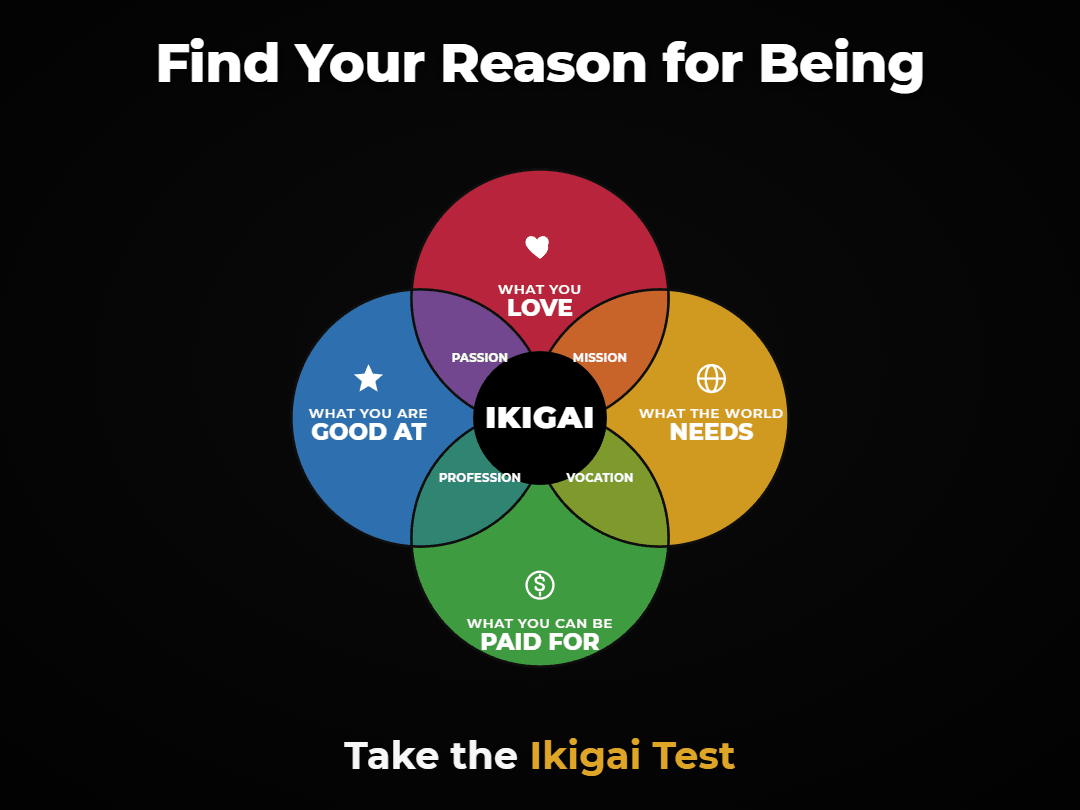
An Ikigai test is a structured self-assessment based on the Japanese concept of Ikigai: the idea that a fulfilling life sits at the intersection of four elements. What you love, what you are good at, what the world needs, and what you can be paid for.
Taking an Ikigai test gives you a clear picture of how those four elements currently relate to each other in your own life, which combinations are strong, which are weak, and where the most meaningful development opportunity lies.
The word Ikigai comes from two Japanese root words. Iki means life or living. Kai means worth, value, or result. Together they translate roughly as "that which makes life worth living." The concept appears in Japanese literature as far back as the Heian period and has been part of ordinary Japanese culture ever since.
In the West, Ikigai is almost always presented as a career framework, a diagram for finding the perfect job. That is a significant simplification. In Japan, Ikigai is more personal than professional. Research by Japanese psychologist Michiko Kumano describes Ikigai as a state of eudaimonic wellbeing: not the pleasure of a good experience but the deeper satisfaction that comes from living in line with your values and capabilities. Japanese people report finding Ikigai in their morning routine, in raising their children, in the craft of a long-held skill, in community. It is not exclusively about work.
The four-circle Venn diagram model most Westerners associate with the ikigai test was introduced in 2014 by a British entrepreneur named Marc Winn, who combined an older Japanese concept with a purpose framework from author Andres Zuzunaga. The result went viral. The diagram is genuinely useful, but it is worth understanding it as a practical tool rather than an ancient Japanese text. The philosophy behind it is old. The visual framework is modern.
This distinction matters because it changes how you approach any ikigai test. Ikigai is not a destination you arrive at. It is an orientation you develop. Your Ikigai will shift as you grow. The test is a mirror, not a map.
Why the four questions in an Ikigai test work
Most purpose exercises fail because they ask one question in isolation. "What are you passionate about?" produces a list of things people enjoy but cannot monetise. "What are you good at?" produces a list of skills disconnected from meaning. Neither gets you anywhere useful on its own.
The Ikigai test works because it holds these four questions in tension simultaneously and asks where they converge.
What do you love?
This is not asking for a polished answer. It is asking what genuinely draws you in: the topics you read about voluntarily, the conversations that make you lose track of time, the work that does not feel like work. Include things that have nothing to do with your current job and things you have not done since you were twenty-three. Do not censor it.
What are you good at?
This is your set of developed skills and natural strengths. People are often blind to their own strengths because they have been using them so long they seem ordinary. If colleagues keep coming to you for the same kind of help, that is a signal worth paying attention to.
What does the world need from you?
This is the question most purpose frameworks skip entirely. What problems genuinely bother you? Where do you see a gap that your presence could help close? This does not have to be grand. Specificity is more useful than ambition here.
What can you get paid for?
This grounds the exercise in reality. It is not asking whether you currently get paid for something. It is asking whether the market values what you can offer. Ikigai without a livelihood is unsustainable. The framework takes money seriously precisely because people who cannot pay their bills cannot live in line with anything.
The power of the Ikigai test is not in any one of these questions. It is in the space where all four overlap.
The Ikigai diagram: what each intersection tells you
The Ikigai diagram shows four overlapping circles arranged in a cross. Each circle represents one of the four questions. The overlapping areas between adjacent circles create four distinct zones. The point where all four circles meet is your Ikigai.
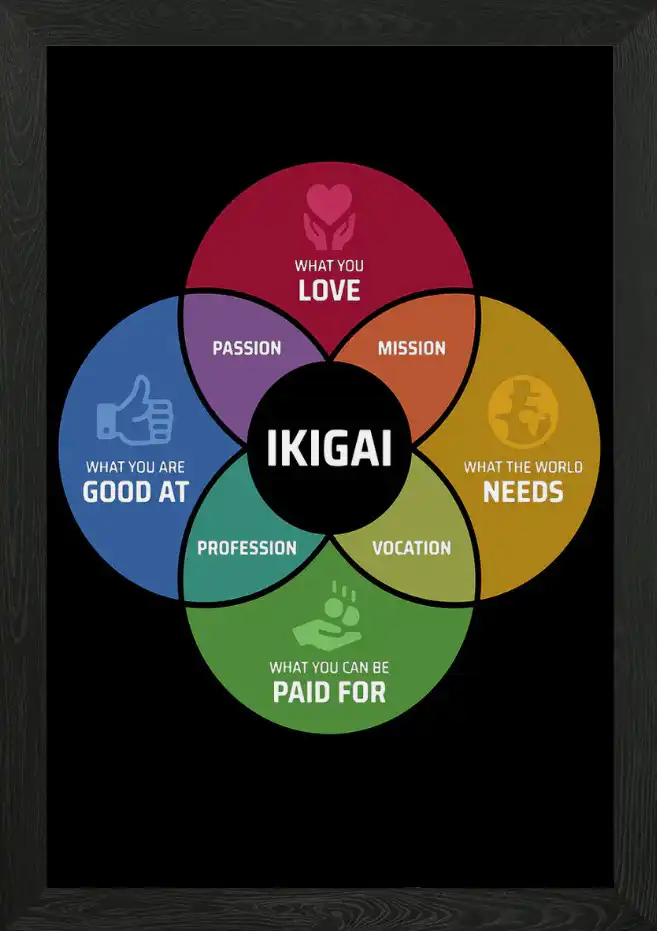
Understanding what each zone means is one of the most practically useful things you can take from an Ikigai test, because most people are living in one of these zones right now, wondering why something feels incomplete.
Passion is the intersection of what you love and what you are good at. Genuinely enjoyable and done well. But without connection to what the world needs or what you can earn, Passion produces delight without direction. Many people who have built a skill around something they love are living in Passion, wondering why it does not translate into income or impact.
Mission is where what you love meets what the world needs. Meaningful work. But without connection to your strengths or a viable income, Mission produces purpose without stability. Burnout is common here.
Profession is the overlap between what you are good at and what you can be paid for. Competent, sustainable work. But without connection to what you love, Profession produces comfort without meaning. Comfortable, but quietly hollow.
Vocation sits between what the world needs and what you can be paid for. Useful, marketable work. But without love and genuine strength behind it, Vocation produces obligation without energy. You are needed, you are paid, and you are going through the motions.
The centre of the ikigai diagram, where all four circles overlap, is where purpose becomes sustainable, meaningful, well-compensated, and genuinely yours.
What makes a good Ikigai test?
Most Ikigai tests available online have the same limitation: they return the same result regardless of what you write. You fill in the four circles on a worksheet, stare at the overlaps, and try to synthesise it yourself. The worksheet is not analysing your answers. It is presenting the structure and asking YOU to do all the work.
A genuinely useful ikigai test needs to do three things.
- It needs to guide you toward honest answers rather than aspirational ones, because the biggest failure mode in any self-assessment is editing your responses for how you want to appear rather than how you actually are.
- It needs to analyse your specific responses rather than map you to a type, because Ikigai is about intersection, not category.
- It needs to tell you what to do next, because a result that accurately describes your current situation is interesting, but a result that tells you which circle is underdeveloped and what a concrete first step looks like is actually useful.
IKIG-AI is built around all three of these requirements.
What is IKIG-AI?
IKIG-AI is a free Ikigai test built by 15DegreesNorth, a specialist B2B SEO, Google Ads, and AI agency based in the UK. It runs inside Claude, the AI assistant made by Anthropic, and uses AI to analyse your specific answers rather than a template.
The analysis at the end of the Ikigai test covers six areas.
- You get a core Ikigai statement: one to two sentences synthesising all four elements into a clear purpose orientation. Not a job title. A direction.
- You get a personalised ikigai diagram: the four-circle Venn diagram rendered in full colour with nine distinct regions showing exactly where your circles overlap.
- You get four intersection cards describing what Passion, Mission, Profession, and Vocation look like specifically for you, based on what you wrote.
- You get a deep insight into your specific combination, surfacing connections you may not have made consciously.
- If one of your four circles is significantly underdeveloped, the test flags it in a development note and explains why that matters.
- Finally, you get three concrete next steps: one action for this week, one for the coming months, one longer-term commitment, all derived from your specific answers.
At the end of the session, a "Copy my Ikigai" button exports the full result as plain text, ready to paste into a document, share with a coach, or return to over time.
How to take the IKIG-AI Ikigai test
The Ikigai test runs inside Claude. You will need a free or paid Claude account at claude.ai.
Download the IKIG-AI file from Here The file is called ikigai.zip. Unzip it, but do not open or edit it. Keep it ready.
Go to claude.ai and open a new conversation. Click the paperclip or attachment icon in the chat input and upload the ikigai.jsx file. Type the following message exactly and hit send:
Render this as a React artifact, display it immediately, no explanation needed:
Claude will build the IKIG-AI interface in the panel on the right. It takes a minute or two to compile. Once the header appears with the IKIG-AI logo and 15DegreesNorth branding, the Ikigai test is ready.
The free tier works for IKIG-AI. A paid Claude Pro account gives faster responses and higher usage limits, but because this Ikigai test makes a single AI call per session, the free tier is unlikely to cause problems for most users.
One practical note: IKIG-AI runs as a React artefact inside your Claude chat window. It is not an installed app or a saved programme. It lives inside the conversation you loaded it in. If you close the conversation, the interface disappears, but it is not gone permanently. Reopen the same conversation and it will be there. Keep one dedicated Claude conversation for IKIG-AI, load it once, name the conversation, and return to it whenever you need it.
Walking through the Ikigai test: step by step
The IKIG-AI Ikigai test is structured as a guided five-step process.
The welcome screen opens with a brief introduction to the Ikigai philosophy, the four circles with their Japanese kanji characters, and a short explanation of what the process involves. Read it before you start.
Each question screen has three reflection prompts, a hint about what the question is really asking, and a tag-based input where you add answers one at a time. You need at least two answers per question to proceed. Ten to fifteen responses across the four questions is a good target.
Once you complete all four questions and click "Find my Ikigai", the test sends your answers to Claude. The analysis typically takes fifteen to thirty seconds, after which your results open with your core Ikigai statement in large type, followed by the ikigai diagram in full colour. Scroll down to read the deep insight, intersection cards, development note, next steps, and your closing affirmation.
How to use your ikigai test results
Start with the intersections, not the statement. The core Ikigai statement is a synthesis. The intersection cards are the substance. Read each one carefully. If any does not ring true, your answers in that circle may need more depth.
Take the development note seriously. The most common blind spot is the "what does the world need from me?" circle. People who are highly capable and well-paid often have a weak connection to external purpose. The imbalance is not a flaw in you. It is a direction to move in.
Use the next steps literally. The first next step is designed to be completable this week. Purpose frameworks that produce no action within a week tend to produce no action at all.
Export and revisit. Use the "Copy my Ikigai" button to export the full result and read it again in two weeks. Your relationship to it often deepens with distance. Run the Ikigai test again in six months. Ikigai is not static, and running it periodically gives you a record of how your purpose orientation evolves.
Who should take an ikigai test?
Professionals at a crossroads will find the Ikigai test useful for understanding what they actually want from a change, rather than simply what they are moving away from.
Business owners and founders often use it to diagnose the gap between where they are and where they want to be. The four-circle framework maps onto business strategy with surprising precision. Founders living in Passion (they love what they do but have not found the market need) or Profession (profitable but personally disconnected) tend to find this particularly useful.
Teams can run individual Ikigai tests and share results voluntarily. It produces a different kind of conversation about roles, strengths, and direction.
HR departments can ask candidates to run an Ikigai test to help with screening for roles.
Students and early-career professionals are well served by understanding the framework early. The earlier you understand it, the better positioned you are to make deliberate choices rather than default ones.
The most common feedback from people who have taken IKIG-AI is not "I found my purpose." It is "I finally know which part of the problem I need to solve."
A note on honest answers
The quality of your Ikigai test result depends entirely on the quality of your input. Two failure modes are worth naming.
- The first is editing for aspiration: listing things you believe you should love rather than things you genuinely do. The result is an Ikigai analysis for the person you want to become, which produces something inspiring that does not translate into action.
- The second is editing for practicality: leaving out things that feel frivolous or unconventional. The result misses half the picture. The ikigai test works best when you write as if no one will see the answers. Because in practice, no one will except the AI.
Why this Ikigai test is different
Most purpose tests give you a label. IKIG-AI gives you a framework. A label tells you what you are. A framework shows you where your specific combination of love, strength, purpose, and livelihood currently sits, which intersection you are living in, which circle is pulling you off-centre, and what a more aligned version of your working life would actually look like in practice.
Ikigai does not fill the vacuum of meaning with optimism. It fills it with specificity. It asks you to be honest about what you actually love, what you are actually good at, what the world actually needs from someone with your particular combination of experience and perspective, and what you can actually sustain financially.
Taking a free Ikigai test takes fifteen minutes. Acting on what it tells you takes considerably longer. But the clarity it produces, about which circle needs strengthening and what a concrete first step looks like, is the kind of clarity that actually changes what you do on Monday morning.
About 15DegreesNorth
15DegreesNorth is a specialist B2B SEO, Google Ads, and AI agency based in the UK. We have been working in B2B search since 2000 and with AI at the beta level since 2020. Five Minds and IKIG-AI are both built from our own internal methodology and made available for free because the tools are only useful if people actually use them.