
AI writing patterns are inside most B2B content operations right now, and very few people want to say it out loud.
AI-generated content has made it faster and cheaper than ever to produce words. Blog posts, landing pages, email sequences and white papers, content that used to take a week now takes an afternoon. The economics are undeniable. The output is not. AI writing patterns are now everywhere and, for the trained eye, pretty easy to spot.
If you have read a B2B blog post in the last eighteen months and thought something feels off about this, you were right. You were detecting the AI writing patterns. The opening starts with a rhetorical question. The paragraph that calls something a "pivotal moment in an evolving landscape." The em dash that appears — like this — every three lines. The conclusion that restates everything you just read as if you had forgotten it. The tone is professionally competent but completely anonymous.
Google is detecting those AI writing patterns too. So are your clients. And the competitors who are still writing with genuine authority are pulling ahead because of it.
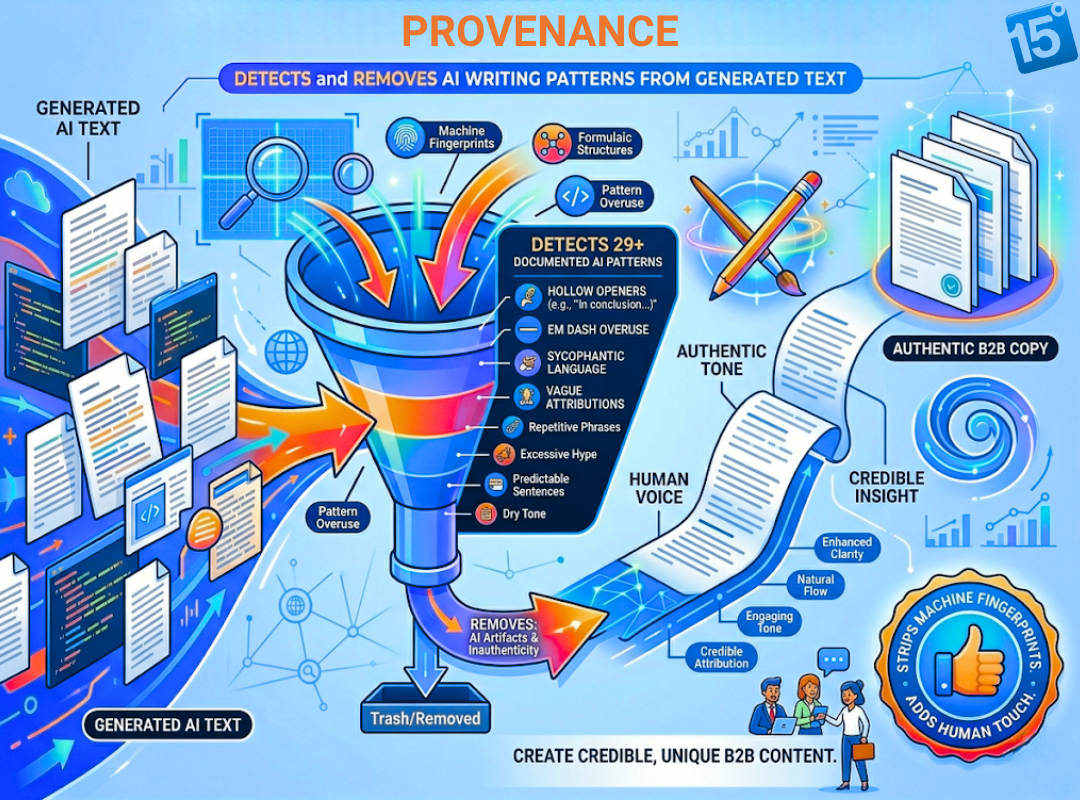
This is the problem Provenance Studio was built to solve. It is a free tool from 15degreesnorth, built on MIT-licensed research by Siqi Chen, that strips the machine fingerprints out of AI-generated content and restores the one thing that is genuinely difficult to manufacture: a point of view.
This article explains exactly what Provenance does, where it comes from, the complete set of patterns it works against, and how to install and use it in Claude in four steps.
Where Provenance Comes From
Provenance v2.5.1 is built on the work of Siqi Chen, released under the MIT license in 2025. The underlying pattern library is drawn from Wikipedia's Signs of AI Writing page, a research document maintained by WikiProject AI Cleanup that catalogues the specific, observable linguistic habits that AI language models consistently produce.
The Wikipedia page exists because AI-generated content became a significant problem for Wikipedia's editorial standards. Volunteer editors found themselves reviewing thousands of contributions that were technically accurate but stylistically broken, written in a voice that was unmistakably generated rather than authored. WikiProject AI Cleanup assembled its findings into a structured reference document describing exactly what those patterns are and why AI models produce them.
The core insight from that research is this: LLMs generate text by predicting what token should come next, based on statistical patterns in their training data. The result is prose that tends toward the most statistically likely construction, which means it converges on the average of everything that already exists. It sounds generic because it is, mathematically, as generic as it is possible to be.
Siqi Chen's contribution was to formalise those observations into an actionable processing brief, a precise set of rules that can be applied to any piece of text to identify and remove the patterns that signal machine authorship. 15degreesnorth took that brief, validated it against our own B2B content work, and built Provenance around it.
Why B2B Content Has an Authenticity Problem
Business-to-business content operates under different rules from consumer content B2C. The stakes are higher. The buyers are more sophisticated. The decision cycles are longer. And the relationship between content quality and commercial trust is direct in a way that simply does not apply when you are selling someone a pair of trainers or some Cornish sea salt.
A procurement director evaluating a six-figure software contract is not reading your blog post to be entertained. They are reading it to decide whether your company thinks the way they think. Whether you understand their world. Whether you have the expertise you say you have. Generic content, however well-structured, fails this test. It says nothing about who you actually are.
The problem is that most AI content tools are optimised for volume, not voice. They produce text that is grammatically correct, reasonably organised, and entirely stripped of personality. Worse, they converge on the mean. Their output sounds like the average of everything that already exists on the web. In B2B, where differentiation is everything, that is a direct commercial liability, and that is an AI writing pattern.
Google's helpful content guidance is explicitly oriented toward rewarding content written with genuine expertise and first-hand experience. Several enterprise procurement processes now ask vendors about their AI content policies. And in professional services, consulting, legal, financial, technology advisory and the implicit promise is that a human expert has considered the client's situation. AI-written content directly contradicts that promise.
What Provenance Studio Does
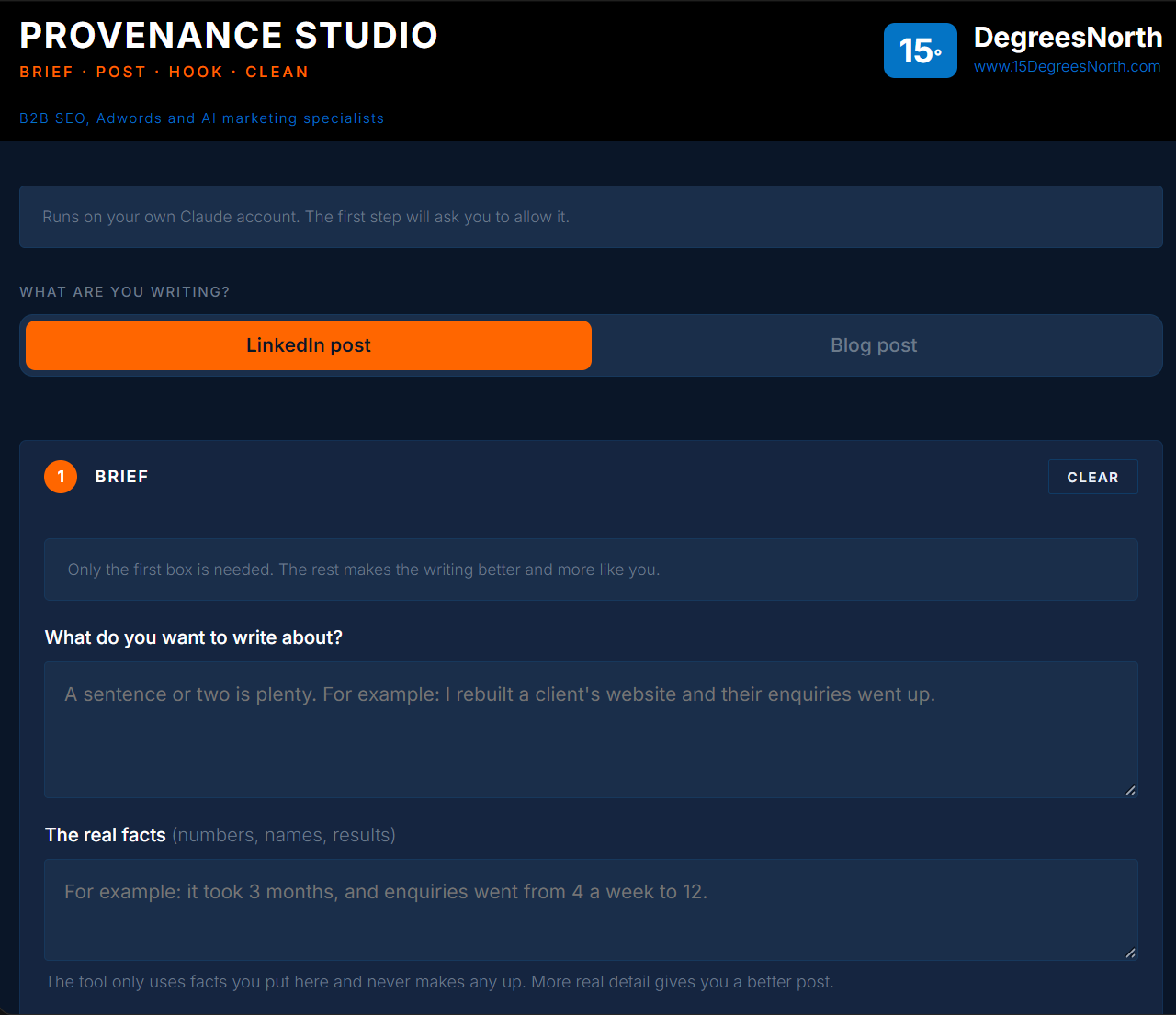
Provenance Studio writes LinkedIn posts and blog posts in four steps, and you can edit the text at every one:
- The brief. You say what you want to write about and give it the real facts: numbers, names, results. It writes only from what you give it and never invents anything. Paste a sample of your own writing and it matches your style.
- The post. It writes the whole post first, before worrying about the opening. For blogs, it plans an outline, gives each fact its own section, then writes the sections one at a time so the length comes out right without padding.
- The hook or title. It finds nine openings inside what it actually wrote. LinkedIn hooks use Diandra Escobar’s hook-writing method in full, and each one is measured against the point where LinkedIn cuts posts off on a phone. Blog titles and descriptions are measured in pixels, the way Google truncates them.
- Finish & Humanise. It runs the Provenance method, based on Siqi Chen’s Humanizer, to strip out 19 tell-tale AI writing patterns. Your facts and your edits stay put, and a panel shows every sentence it changed.
Throughout, the things that can be counted are checked in code rather than left to the AI: em dashes, banned phrases, percentages with no base number, and claims that quietly got stronger than you wrote them.
The 19 AI Writing Patterns Provenance Strips Out
This is the complete rule set that Provenance applies, drawn from Siqi Chen's pattern library. Every item below is a documented signal of machine authorship. Run your own content against it and count how many appear.
1. Significance Inflation
Words and phrases that inflate importance without adding information: "pivotal moment," "evolving landscape," "testament to," "underscores," "highlights." These are filler words dressed up as emphasis. Real significance comes from specific evidence, not inflated adjectives.
2. AI Vocabulary
A distinct set of words that appear at abnormally high frequency in AI-generated text: "delve," "vibrant," "tapestry," "foster," "showcase," "crucial," "align with," "intricate," "garner." These words are not wrong, but their clustering in the same piece of text is a reliable tell. Human writers distribute their vocabulary more variably.
3. Superficial -ing Phrases
Phrases appended to sentences to create the appearance of connection: "symbolising...," "reflecting...," "contributing to...," "demonstrating..." These phrases gesture toward meaning without establishing it. They tell the reader how to feel about a fact rather than presenting a fact that generates a feeling.
4. Promotional Language
Adjectives that describe rather than analyse: "nestled," "breathtaking," "groundbreaking," "stunning," "renowned." These are the vocabulary of marketing copy and travel writing. In B2B content, they read as either naive or untrustworthy.
5. Vague Attributions
Claims cited to nobody in particular: "experts argue," "industry observers suggest," "some critics believe," "research shows." These attributions give the appearance of evidence without the substance of it. Real expertise cites specific sources or owns its claims directly.
6. Sycophantic Openers
Responses that acknowledge before they respond: "Great question!", "Certainly!", "Of course!", "Absolutely!", "I hope this helps." These are an artefact of a conversational AI trained to be agreeable. They have no place in authored content.
7. Em Dash Overuse
A personal hate of mine :). The em dash is a legitimate punctuation mark. Used once or twice in a piece, it creates useful emphasis. Used every three lines — like this — and again here — it becomes a textural tell. AI models are heavily biased toward the em dash as a way of creating the appearance of conversational informality.
8. Excessive Bolding
Bolding random phrases throughout running prose rather than using it selectively for genuinely critical terms. This pattern creates visual noise and suggests the writer did not trust the prose to hold attention on its own merits.
9. Rule of Three Padding
AI models are strongly biased toward three-item structures. Arguments are divided into three points. Sentences that list three examples. Sections that identify three challenges. Real subject matter does not divide neatly into three. When the structure forces it, the third item is almost always padding.
10. Generic Positive Conclusions
Endings that resolve into optimism without earning it: "the future looks bright," "exciting times lie ahead," "the possibilities are endless," "there has never been a better time to..." These conclusions exist because AI models are trained to resolve rather than to argue. They are the content equivalent of a shrug. Have you ever finished an AI session and not felt pleased?
11. Negative Parallelism
The pattern: "It's not just X; it's Y." Or: "This isn't simply about X, it's about Y." Used occasionally, this structure has genuine rhetorical force. AI models overuse it because it signals depth while requiring none.
12. Copula Avoidance (Love that word, must make a point of using it more in conversation)
"Serves as," "stands as," "acts as," "functions as", used where "is" or "are" would do the same job more directly. This is one of the more consistent AI tells because the avoidance is systematic. The model has learned that "serves as a reminder" sounds more polished than "is a reminder," and applies it across all contexts regardless of whether it is appropriate.
13. Filler Phrases
Multi-word constructions that can be replaced with single words or deleted: "in order to" (→ to), "due to the fact that" (→ because), "at this point in time" (→ now), "it is important to note that" (→ delete). These phrases make writing longer without making it more informative.
14. Excessive Hedging
Stacked qualifiers that strip claims of all force: "could potentially possibly be argued," "might in some cases tend to suggest," "it is perhaps worth considering." A single hedge is appropriate epistemic humility. Multiple stacked hedges signal that the writer (or model) is avoiding a position rather than expressing one.
15. Knowledge-Cutoff Disclaimers
Unprompted reminders that information may have changed since a training cutoff date. These are a direct artefact of the model's architecture appearing in published content. They have no place in the authored copy.
16. Collaborative Artefacts
Phrases that make sense in a chat interface but not in a finished document: "let me know if you'd like me to expand on this," "here is a draft for you to review," "I hope this gives you a starting point," "feel free to adjust the tone." These are the AI talking to the prompter rather than writing for the reader. People often leave these in because they don't go through the AI content and manually edit it!
17. Passive Voice Hiding the Actor
Not all passive voice is problematic. Passive voice that systematically removes the actor from sentences that have an obvious actor is. "Mistakes were made," "it has been argued that," "decisions were taken", when the who matters, name them. AI models default to passive constructions because they are structurally safer.
18. Inline Header Bullet Lists
The pattern of creating a bold phrase at the start of each bullet point that functions as a mini-heading, followed by a sentence of explanation. This structure appears constantly in AI-generated content because it is easy to generate and creates the visual impression of organised thinking. Real organised thinking usually produces prose.
19. Title Case in All Headings
Capitalising Every Word In Every Heading, regardless of whether the heading is a title or a sentence. This is an AI default borrowed from US style guides and applied indiscriminately. Sentence case, where only the first word and proper nouns are capitalised, is standard in UK English and reads as more considered.
Now here is a classic SEO "It Depends" moment. If I am creating a Google Ads ad I will use sentence case on every word because I know from experience that it captures the eye faster when the ad appears, and so the click-through rate is better. But yeah. It depends.
How to Install and Use Provenance in Claude
Provenance runs in Claude. You need a Claude account; the free tier at claude.ai works, and the Provenance html file is available via the download link below.
Download Provenance Studio: PROVENANCE It's free, and no account or purchase is required; no email is needed either.
The full process takes about two minutes the first time. After that, it is a single upload and a single message.
Step 1. Download the Provenance Studio zip file
Click the download link above.
You will receive a single html file in a zip. Save it somewhere accessible. Unzip it.
Step 2. Open Claude and start a new conversation
Go to claude.ai and open a new conversation. The free tier is sufficient. Claude Pro (around £18 per month) gives faster responses, which matters because Provenance Studio makes several API calls per run, one for the initial draft rewrite, one for the self-critique audit, and one for the final clean version. The output is identical on either tier.
Step 3. Upload the html file and ask Claude to render it
Click the paperclip or attachment icon in the chat input. Upload the Provenance html file. Then type the following message exactly and hit send:
Publish this HTML file as an artifact exactly as it is, without changing anything. Declare the sample capability so it can use Claude, then open it.
Claude will build the Provenance Studio interface in the panel on the right side of your screen. This typically takes between five and twenty seconds, depending on your connection.
Step 4. Paste your content and run
You will see two input areas in the Provenance Studio interface: Select either Linkedin posts or Blog Post and then just follow the prompts down the page.
Use It on Drafts, Not Finished Copy
The most effective point to run Provenance is on a first AI draft before any human review has taken place. Running it on polished copy can strip things that were deliberate. Running it early gives you a clean foundation to build from, rather than a patched-up version of something already compromised by layer upon layer of revision.
Feed It Content Longer Than 300 Words
The pattern library operates on context as well as individual phrases. Content under three hundred words does not give Provenance enough signal to operate accurately. For short-form assets, social posts, subject lines and CTAs, a manual review using the pattern list above is more reliable than running the tool.
Layer Your Own Voice After Running It
Provenance removes the generic. It does not add the specific. After running your content through the tool, read it as the expert you are: Are there points where you would genuinely push back on the conventional view? Are there examples from actual client work that would make an abstract claim concrete? Are there sentences that are technically accurate but would only be written by someone who does not really understand the subject?
The copy that comes out of Provenance is the floor. Your actual point of view is the ceiling.
Which Content Types Benefit Most
From our own use and client work, the content types that produce the biggest improvement through Provenance are:
- LinkedIn content, where the audience is sophisticated, and the density of AI-pattern content is high enough that the genuine voice is immediately visible
- Long-form blog posts and articles, where voice and perspective are the primary differentiators and generic patterns are most visible
- Landing pages and service descriptions, where trust is built through specificity, and promotional language actively undermines it
- Email sequences, where readers experience AI patterns at close range, and the relationship cost of generic copy is highest
- White papers and thought leadership, where the implicit claim is that a human expert is speaking, and that claim must be true in the texture of the writing, not just the byline
Content types where Provenance adds less value: technical documentation, data-heavy reports, product specifications, and anything where information transfer rather than relationship building is the primary purpose.
Why This Matters for Your B2B SEO Strategy
We built Provenance Studio because we kept seeing the same thing in client content audits: technically competent content producing no engagement, no inbound links, no brand recognition, and no pipeline. The content ticked the SEO boxes, right keywords, right structure, right length, and it still underperformed.
In most cases, the issue was not strategy. It was a voice. The content was recognisable as content but not recognisable as that organisation's thinking. Present in the search results but invisible as a brand.
Google Is Getting Better at Detecting These Patterns
Google's helpful content system is designed to reward content that demonstrates genuine expertise, first-hand experience, and a clear purpose for the person reading it. Content that is generated at scale, stripped of specific perspective, and optimised primarily for keywords is exactly what this system is designed to deprioritise. So yes, AI CAN and does detect AI writing, but again, "It Depends".
If the author is lazy and produces AI slop en masse, Google will detect it and just stop showing those pages (impressions) to new visitors.
This does not mean AI-assisted content cannot rank. It means AI content that reads as AI content faces a structural disadvantage. Organisations that combine AI's efficiency with a genuine human voice will hold and grow their rankings. Organisations shipping raw AI output are betting against an algorithmic trend that is moving in one direction.
Engagement Signals Are a Ranking Factor
The time a reader spends on a page, whether they read to the bottom or whether they return! These signals feed into how Google evaluates content quality. Generic AI content produces high bounce rates because experienced readers detect the patterns within the first three sentences and leave. Content with a point of view gets read. Content that gets read gets ranked. Bounce rate is a huge factor.
In B2B, Content Is a Credibility Signal
The commercial value of B2B content is not primarily measured in traffic. It is measured in what happens when a prospect reads it. Does it make them trust you more? Does it make them more likely to start a conversation? Does it demonstrate that your organisation has a genuine understanding of their challenges?
The difference between B2B content that builds trust and content that erodes it is often not strategy, not structure, and not keywords. It is whether there is a recognisable human intelligence behind the words.
About 15degreesnorth
15degreesnorth is a B2B SEO and digital marketing agency. We have been working with B2B organisations for nearly three decades, on search strategy, content programmes, paid search, and the commercial thinking that turns organic visibility into pipeline. Money in other words.
We built Provenance because we use it ourselves. It is part of how we maintain content quality across client programmes where AI is part of the production process. We released it as a free tool and ensured the attribution to Siqi Chen's underlying research is properly maintained because the B2B content problem it addresses is broad enough that keeping it proprietary made no sense.
If you are working on a B2B content strategy and want a conversation about how to combine AI efficiency with the authority-led content that actually moves buyers, we would welcome that conversation.
Get in touch using this form Contact Us
The Bottom Line
AI content tools are not going away. Neither is the problem they create, AI writing patterns! As every B2B content team gets access to the same generation capabilities, the volume of competent but generic content (AI Slop) will continue to rise. The 19 pattern categories in Provenance's rule set are not testing edge cases, they are the default output of every major AI writing tool. They appear because the models are optimised to produce the most statistically average text possible.
The organisations that will pull ahead are those that use AI for what it is actually good at: structure, speed and coverage and then apply human judgment to what it cannot replicate: genuine expertise, a specific point of view, and a voice that sounds like someone you would actually want to do business with.
Provenance is a practical tool for that problem. It is built on rigorous open research from Siqi Chen and the Wikipedia AI Cleanup project. It is free, it is transparent about what it does and why, and it produces copy that sounds like it was written by the expert your clients are paying to work with.
Download Provenance Studio run it in Claude, and publish content that sounds like you again.
Mark